
Subwoofer Design for the New Digital and Analog World.
| 
|
From cellos to earthquakes
| "With one twelve-inch driver similar to those in the Grand Reference and a critically-tuned, all-wood, heavily braced box, what we have here in the TBolt III is a baby Tyrannosaurus Rex of the subwoofer field: fast, vicious in its attack, and thunderous in its power." - the abso!ute sound, December 2005 |
Simply stated, a small lightweight driver will exhibit rapid start and stop capabilities, but very little low bass output, whereas a large heavy driver will exhibit substantial low bass output, but slow start/stop capabilities. In both cases the sound and realism suffer.
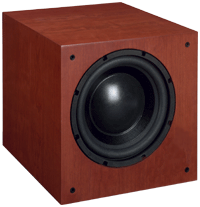
This ultimate system redefined what a loudspeaker is capable of. One area where the Grand Reference System changed the rules is bass response. After extensive experimentation, a special 12-inch driver was developed. A blend of natural and synthetic fibers was formulated to create a woofer cone that is both extremely rigid, yet lighter in weight than Kevlar, aluminum, magnesium and titanium cones. A voice coil was developed to provide ultra long excursion, while dramatically reducing the distortion producing back EMF. An extremely rigid cast frame was engineered to support the huge magnetic structure required to control this outstanding woofer. This Grand Reference Subwoofer uniquely provides both rapid response and extremely low continuous frequency response at very high output levels.
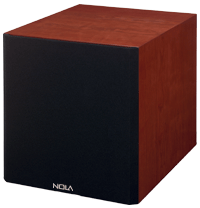
We then took the Grand Reference Subwoofer concept and developed the T Bolt III Subwoofer, an innovative subwoofer that has both the high-speed attack of a small woofer and the enormous energy at low frequencies of very large woofers. The Grand Reference concept T Bolt III Subwoofer provides powerful and dynamic yet detailed reproduction to recreate reality at all sound levels, from very soft and delicate to very loud and powerful. This wide range dynamic contrast is lacking in other subwoofers, both large and small.
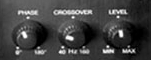 The input stage is Class A with variable controls for level and
crossover. In addition, unlike most subwoofers that provide either no
phase control or only a 2-position switch, the T Bolt III has a
variable phase control to allow freedom of room placement and the best
possible blending with your system's speakers.
The input stage is Class A with variable controls for level and
crossover. In addition, unlike most subwoofers that provide either no
phase control or only a 2-position switch, the T Bolt III has a
variable phase control to allow freedom of room placement and the best
possible blending with your system's speakers.
Circuit
Unlike most built-in subwoofer amplifiers that run in high distortion modes such as Class B, or even worse, Class D switching, our output stage runs in Class A/B mode and is also fully discrete. This is the same type of circuitry found in expensive high-end amplifiers. Our advanced amplifier circuit is then mounted in an enclosed protective chamber within the subwoofer. This isolates the circuit from the subwoofer chamber itself, thus preventing the subwoofer from vibrating the components and causing micro-phonic distortion.
We are using the same technique for creating the T Bolt III subwoofer as we developed for the no compromise Grand Reference Speakers. However, the Grand Reference subwoofer cabinets are over 6 feet tall! For the T Bolt III, we were able to generate fast deep powerful bass with a cabinet smaller than a foot and a half cube, so it easily fits into any room and décor.
Construction
The cabinet is constructed entirely of one inch thick, 46 pound density MDF. For speaker cabinets this MDF is far better than solid wood or metal because it has self-damping properties, which reduce unwanted spurious vibrations. An inner chamber of MDF is then constructed for the amplifier. This box-within-a-box construction creates a tightly sealed, exceptionally rigid cabinet. These exceptionally rigid MDF panels are bonded with wood adhesive rather thanthe cheaper and environmentally unstable hot melt glue found in other subwoofers. Unlike virtually all other subwoofers, the cabinet is clamped while the adhesive dries, creating the highest solidity possible. This lack of flex ensures tight and controlled bass response. It is then sanded and finished to the highest woodworking standards. There is no plastic or vinyl used in the construction of the T Bolt III cabinet.
Front Baffle
Flex in the cabinet or the mounting system would negate the rigidity developed for our woofer cone. In order to increase rigidity, the driver is mounted to a unique dual front baffle. The inside baffle reinforcement is bonded to the 1 in. thick outer baffle. The very heavy and rigid cast driver frame is mounted to the inner baffle and is tightly surrounded by the outer baffle. In addition we do not use a conventional foam or rubber gasket to seal the driver to the cabinet. The driver is sealed to the inner baffle with a flexible material that adheres itself to both the driver frame and baffle, forming a perfect seal. In fact the adhesion is so complete that if the screws were removed and the cabinet turned with the driver facing down, it would not fall out. (Warning: Don't try this at home!)
We engineer for reality, not hype. Those that engineer for hype like to give specifications that imply performance, rather than give actual performance. Watts, in a powered subwoofer, are a perfect example of meaningless hype and useless information. They want to mislead you into believing that the higher the quoted wattage, the louder, deeper and better the subwoofer's performance. However, as an example, a high mass subwoofer will require several times more power to drive it to the same output level as a low mass subwoofer. You can't hear amplifier wattage until it causes the speaker cone to move, which is why we won't mislead you by quoting the meaningless wattage spec. How much wattage do we provide? The wattage we provide is ample enough to audibly drive the T Bolt III to exceptionally high output levels.
How many decibels?
Another specification loaded with hype is how loud the subwoofer will play measured in dB. For instance, some manufacturers will place the subwoofer's resonance at a frequency measurable within the subwoofer's output range in order to boost output at a particular frequency so they can quote a high dB number. They put the resonance at say 20Hz or 30Hz and then quote the output at this frequency. However, all the resonance does is create an uncontrolled peak in sound that vibrates for an extended period of time, smothering other frequencies in the original signal. This is why we won't join in the dB spec hype. The T Bolt III is capable of shaking your home theater room the same as a sudden nearby thunder strike or earthquake jolt because it has the deep power of a very large subwoofer, with the attack time of a very small subwoofer. This creates a unique reality and loudness at low frequencies that will be immediately appreciated upon first hearing. How loud is the T Bolt III? Loud enough to provide more frightening low end impact than any competitor's subwoofer.
Rigidity - Because a subwoofer needs to move a lot of air to recreate low frequencies you can hear and feel, they need to be resistant to deformity from the significant air pressure pushing against the driver inside the cabinet. Therefore, the subwoofer cone, frame and cabinet need to be rigid in order to provide the required force without the deformation that causes distortion.
Back EMF - the electro-magnetic field created by the subwoofer's voice coil. This electro-magnetic field generates a current that is sent back to the amplifier altering the current the amplifier is sending to the subwoofer. This causes the two signals to combine and distortion to occur.
Some have attempted to utilize a small bass driver with high mass and long excursion, fed by high power. The driver mass is significantly increased in an attempt to reduce enclosure size. However, the high mass, because it has high inertia, works against rapid start and stop action. Low frequency transients lack sudden and immediate impact because the excess mass cannot be accelerated rapidly. Long duration, low frequency tones bury the other frequencies the subwoofer must reproduce, because the driver's high mass, due to momentum, is very slow to stop. Consequently, these subwoofers are known for their "one note bass".
Passive radiators
Passive radiators have much higher mass than an equivalent port. In a port, the moving mass is comprised of the air in the port. Obviously, the air has extremely low mass. The mass of the passive radiator, on the other hand, is high because it is the mass of the moving cone system, which may be as high as the powered driver cone. Under this condition, when the powered subwoofer cone stops, the passive radiator's cone continues to move for a variable length of time. In fact, because the mass of the passive radiator is high, it is capable of causing the powered driver cone itself to move after the signal has stopped. The moving driver cone again causes the passive radiator to restart. This "ping-pong" effect continues until the damping in the system finally causes both cones to stop, which can be long after the initial signal has ended. This obviously causes significant smearing of the sound and again results in "one note bass."
Servo controls
The servo control circuit compares the subwoofer's output to the input signal through a feedback circuit. This circuit attempts to adjust the input to compensate for the driver's output errors. Unfortunately, this circuit, no matter how quickly it responds, cannot make the required correction until after the error has occurred. Consequently, the correction is always arriving at the subwoofer's output with the next signal. The correction, therefore, occurs on the wrong signal and has the effect of compressing transients and removing impact.
We maintain the stringent rigidity required for the overall system by constructing a cabinet entirely of one inch thick, 46 pound density MDF panels bonded with wood adhesive and completely clamped during the drying process. To further reinforce the design, we created a dual front baffle, "box-within-a-box" construction, which creates a completely sealed, exceptionally rigid cabinet.
We developed a unique voice coil which provides ultra long excursion with very greatly reduced back EMF, helping to provide a subwoofer system with intrinsically low distortion.
Our amplifier's output stage employs discrete components and runs in Class A/B mode to provide the performance level associated with the finest high-end amplifiers.
These timely advancements in bass reproduction will be immediately evident, whether heard at your dealer or in your own personal system. The speed, attack and depth of the T Bolt III's deep bass will inspire awe in even the casual listener. Its ability to create an exceptionally deep continuous room-filling rumble is unsurpassed by even oversized, conventional subwoofers. Yet the T Bolt III's control preserves the true timbre, intimacy and beauty of even the most delicate sounds of the smallest chamber music group.
The T Bolt III improves upon the original Thunderbolt Subwoofer with a new cast woofer frame for increased rigidity and an improved cabinet design.

|
| ||
|
System Type: Powered, front firing ported subwoofer Front firing allows it to be placed in various locations, such as in a cabinet, without affecting performance.
Driver Diameter: 12 inches
Driver Construction: A blend formulation consisting of both natural and synthetic fibers
Response: 20Hz to 160Hz
Crossover Frequency: Continuously variable low pass 40Hz to 160Hz, fixed high pass 100Hz
Phase: Continuously variable from 0 to 180 degrees
Power:Manual or auto on/off, detachable power cord, 120 or 240 Volt operation
Amplifier: Fully discrete Class A/B outputs
Finish: Black or cherry wood veneer
Cabinet Size: 16" H x 16"W x 18"D (20"D with allowance for grille and power cord) Weight: 85 lbs.
| ||
|
| ||
 Link to this page