A Reprint from May 1999, Vol.22 No.5

Equipment Reports
Acarian Systems Alón Circe loudspeaker
Wes Phillips
 Who knows not Circe,
The daughter of the Sun, whose charmed cup
Whoever tasted, lost his upright shape,
And downward fell into a groveling swine?
John Milton, Comus
Actually, maybe you know not Circe, so here's a refresher: When Odysseus landed on Aeaea, Circe placed an enchantment upon his crew, turning them into swine. Odysseus was unaffected because he was protected by an herb called Moly, a gift of Hermes, and he forced Circe to restore his crew's human forms. Odysseus then hung out with her for a year (fathering Telegonus, among other pastimes) before she dispatched him and his shipmates off to the underworld to consult Tiresias.
|
Description: Floorstanding three-way dynamic loudspeaker system
with external passive crossover. Driver complement: 1" aluminum-dome
tweeter mounted on open baffle, 5.5" pulp/plastic-cone midrange on
open baffle, 10" pulp-cone woofer in sealed enclosure. Crossover
frequencies: 400Hz, 3500Hz. Frequency range: 20Hz-25kHz. Sensitivity:
87dB/W/m. Impedance: 8 ohms nominal, 4 ohms minimum. Dimensions: 52.5" H by 12.75" W by 15" D. Weight: 130 lbs each. Serial number of units reviewed: 101/102. Finish: Cherry with black cloth. Price: $12,000/pair. Approximate number of dealers: 60. Manufacturer: Acarian Systems, Ltd., 181 Smithtown Blvd., Suite 104, Nesconset, NY 11767. Tel: (516) 265-9577. Fax: (516) 265-9560. Web: www.alonbyacarian.com .
|
What's the audio connection? No clues here -- unless it's that this Circe, from Alón by Acarian Systems, also is capable of casting a spell. Certainly that seemed the case at HI-FI '98 last June, where the sound in the Acarian Systems/Cary room was the talk of the Show. Didn't see 'em change anyone into a swine, though--anybody who left the room a pig had probably walked in that way.
Evolution is a change from an indefinite, incoherent homogeneity,
to a definite coherent heterogeneity.
The Circe is a floorstanding three-way system with an external passive
crossover. Designer Carl Marchisotto explains, "We use an external
crossover to reduce degradation caused by the crossover components
being vibrated or modulated by magnetic fields within the
speaker. Obviously, inside the speaker is not the best place to mount
a sensitive electronic device." The crossover contains three separate
boards -- one for each driver -- and has a hard-wired harness of
Alón's own Black Orpheus cable connecting it to the Circe's
three sets of binding posts. It also has three pairs of posts, which
accept the speaker wire from the amplifier. Marchisotto recommends
triwiring the crossover to the amplifier, thus keeping the signal
paths discrete all the way back to the amp. Reacting to complaints
that triwiring a speaker can lead to cable costs higher than that of
the speaker itself, Marchisotto developed his own speaker cable, Black
Orpheus, and offers a 10' triwired harness for $550. The bass cable
uses coaxial construction, with a solid inner core and a braided outer
layer made of silver-plated copper, both metals oxygen-free. The
midrange and HF cables are uni-axial, using silver-clad strands and
OFC in the same bundle. The cable is roughly equivalent to 13 AWG.
"We take some flak over our use of a very thin insulation,"
Marchisotto notes; "some people equate a thick cable with a good
cable. But in audio we're not dealing with high voltages, and thick
dielectrics load up the capacitance, which causes losses."
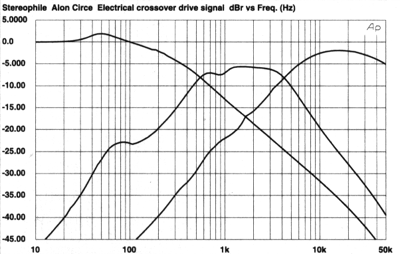
Marchisotto is not exactly forthcoming concerning the crossover technology. "It's not a classical crossover. The slopes are sharper than a first-order but not as sharp as a second-order."
"So what does that make it?" I asked.
"A good crossover."
Ah.
The Circe itself is reasonably understated in a Vandersteen sort of way. The whole unit is clad in black fabric, with a cherry-wood top cap. The sealed bass enclosure houses a 10" long-throw pulp-cone woofer. On top of this cabinet is a small slanted baffle that houses a 5.5" pulp-cone midrange unit and a 1" aluminum-alloy dome tweeter. The two upper-range drivers are set into the baffle, which is open to the rear, so that they perform as dipoles. Wooden dowels support the decorative top plate above the baffle board and provide a framework for the speaker cloth.
All three drivers employ alnico magnets, which Marchisotto prefers for their "better fidelity, lower distortion, better low-level resolution, and more stable magnetic field, which translates into a more musical (more authentic, I think) harmonic structure. Alnico magnets also provide a more realistic sense of dynamics."
The midrange and woofer cones are made of pulp-based materials: Long-fiber wool is used for the woofer, while the midrange driver has a double treatment layering two different plastics over a pulp base. Marchisotto is adamant: "We prefer the low-level resolution and more natural sound of pulp-based drivers because we have found that alloy and higher-tech materials have colorations that cannot be totally compensated for in the crossover in the midrange. The HF driver is an aluminum-magnesium alloy. We don't mind using a metal dome for this frequency range because the resonance is above 25kHz, which is outside the range of hearing. Internal wiring is Black Orpheus. The six pairs of binding posts are substantial solid-copper Cardas Musicposts, which Marchisotto leaves unplated, preferring their sound that way.
If we want things to stay as they are, things will have to
change.
Maybe it was Circe's transformative powers that
inspired the speaker's name. As I shuffled amplifiers and wires, the
speakers went through some real personality changes. Marchisotto is
insistent that the Circes be used only with components of the very
highest quality, which, for him, include single-ended triode
amplifiers such as the Cary CAD-805C monoblock. So I had Dennis Had
send me a pair and began the proceedings with a Marchisotto-approved
system consisting of an Audio Research CD2/DAC3 or Linn Sondek
LP12/Lingo/Cirkus/Ekos/Arkiv/Linto front-end driving the
Conrad-Johnson ART and Cary 805C combo.
First, we spent a great deal of time finding the right interconnects. Two that worked well were the Siltech SQ-80 G3 and AudioQuest Lapis. There are probably other cables I could have tried, but cable comparisons aren't high on my list of fun activities. I can hear the tonal purity that people respond to in single-ended amplifiers, but I suspect I'm just not an SE kinda guy at heart. The highs were sweet and lovely, but I found the Circe's overall sound flaccid and very old fashioned with the 805Cs. Nor was I getting the low-level resolution I thought a $12,000/pair loudspeaker ought to exhibit. It was as if I'd stepped back in time 25 years. By dialing in more negative feedback, I did get the amp to control the bottom end better, but the top end's purity suffered as the bass tightened up. For my tastes, and in my room, this was not a magic combination.
taut, tuneful, and quite deep."
The far more powerful Audio Research VT200 was a different kettle of fish entirely. Highs were now extended and detailed -- less sweet, perhaps, but light-years removed from harsh or forward. The midrange was extraordinary; I could hear waaay into recordings now. And the bass was impressive as the dickens. I got similar results when I tried a Mark Levinson No.332 and a pair of Accuphase M2000s, but the overall harmonic signature was considerably less rich. I don't go so far as to insist on SE triodes, but tube amplification sure did seem to bring out the best in the Circe. One other setup consideration: Since the Circes are dipoles above 400Hz, you must position them carefully. They need breathing room to their sides and, in my room at least, quite a bit of space behind them. In a rectangular room, I'd start with them placed on the long wall first. In some rooms they might benefit from some slight toe-in, but not in mine -- I pointed 'em straight forward, about 6' apart and 4' from the front wall, with my listening chair 10' in front of them.
The one remains, the many change and pass.
If'n you ask me, the Alón Circe needs a fairly hefty
amplifier. But properly driven, the Circe delivers the bass
goods. The bottom end is taut, tuneful, and quite deep. I really
enjoyed listening to recordings with extreme low-frequency
information, such as Robert Rich's Seven Veils (Hearts of Space
11086-2), an electroacoustic fantasy on Eastern trance-inducing
music.
I realize that a lot of audiophiles have nothing but contempt for this whole genre of music, claiming that since it is an artificial construct, without reference to a real-world performance, it is thus not as worthwhile as more "authentic" music types, which at least are performed in concert halls, stadiums, drawing rooms, or coffee houses. But this is a false distinction, to my mind, once we're talking of recordings -- unless we're referring to that very small handful recorded in a purist two-mikes-in-a-hall fashion. Almost any studio recording these days has an audio environment constructed by its engineer, who chooses how much acoustic space informs the instruments, and where the instruments are represented in the soundstage -- to the point where different instruments in the mix may be informed by different acoustics, even when recorded in the same space at the same time. The best "soundscape" manipulators, such as Rich, create sonic worlds as rich and fascinating as any captured by the purists -- some might even argue more so.
Seven Veils sounded fantastic on the Circes. The bass was incredibly deep and articulate, brimming over with warmth. The differences in the manipulated acoustics used in each piece were easily distinguished. The admittedly artificial soundstage didn't sound that way -- Rich is a genius at constructing believable soundscapes, and the ones on Seven Veils are convincing.
The bass on Jimmie Vaughan's Out There CD (Epic EK 67653) was powerfully boogielicious as well. Vaughan doesn't use a bass player, most of the bottom on this disc coming from his own tasty guitar work and Bill Willis' Hammond B-3. Yet on this disc as well, I was aware of a bottom-end warmth quite different from that of the similarly priced B&W Nautilus 801 that I reviewed in January.
Is this a characteristic of the Circe, or the difference between a well-designed ported enclosure and a sealed-box design? I can't say for sure, but the Circe's bass signature reminded me of the AR-3 and the larger Advent loudspeakers -- classic designs from my youth. Not bad company to keep, but representative of a sound that won't appeal to everyone. I have to admit I find it quite attractive, but I'm not sure I'd want to experience it every day.
The midrange and top end certainly do not partake of any classic coloration, however. Time after time, I was drawn into the music through the exceptional purity of the Circe's mids and highs. Voices and winds sounded remarkably present. Having played (badly) in my day a fair amount of recorder and end-blown flute, I'm intimately familiar with the sounds of these instruments, and most recordings (and hi-fis) tend to blunt the sharp harmonics they produce. In a recorder ensemble, no matter how mellow the primary tones, the overtone structures are filled with clangor, a property the Alóns reproduced with astonishing verisimilitude on the Flanders Recorder Quartet's Armonia di Flauti (CD, Opus 111 OPS 30-201). The speakers reproduced not just the sound of four recorders, but also that of the space in which they were being played, with an immediacy that bordered on the frightening.
Here's a funny thing: My old Verve and Milestone LPs sounded fantastic on these speakers. Of course, many of them are just great-sounding records, but there seemed to be an affinity between the Alóns and my vintage jazz discs that just worked magic. Some of this might be attributed to that hint of bass warmth -- which certainly did suit the bass lines of Leroy Vinnegar, Ron Carter, Reggie Workman, et al -- but that wasn't all of it. There was a rightness and balance to these '60s-era discs that was impossible to deny. I can't explain it, but I certainly did dig it.
One other minor quibble: The Circe seems voiced for seated listening- stand up and there's a shift in perspective that, while relatively minor, I found slightly disconcerting. This isn't the huge tonal change you get with some loudspeakers, but rather a shift in the soundstage. Seated, I was surrounded by the stage, looking into it in front of me. When I stood, the soundstage shrank. It seemed as if I was looking down into it from a balcony. This may not bother everyone as much as it did me, but some performances draw me to my feet -- and such a change in perspective takes me out of the music for an instant. Bummer.
It would be tempting to blame this on the top plate, which is only 4.5" above the tweeter and just has to affect its dispersion. But it could be a crossover artifact instead.
|
Associated Equipment
LP playback: Linn LP12/Lingo/Cirkus/Ekos/Arkiv. -WesPhillips
|
I recently reviewed the B&W Nautilus 801 (January 1999, Vo1.22 No.1), whose $11,000/pair price is quite close to the Circe's $12,000/pair. Both speakers are quite sensitive to the ancillary components that must be used with them. But the two speakers sound quite different from one another, and I don't imagine they'll appeal to the same listeners. The B&W is dynamic as all get out, and can play loud enough to cause structural damage. The Alón did a superb job of presenting dynamic contrasts and shadings, and played plenty loud enough for me - even in head banging moods -- but didn't convey the same sense of unlimited dynamic potential as the N801. This is an area where different people will react according to their nature. Not everyone needs to peel the paint off their walls with sheer loudness.
Allied with this sense of greater loudness potential, the B&Ws also seemed to possess greater volume in terms of soundstage size. The N-801s just projected more sonic real estate. The Circes' soundstage was detailed and densely packed with information, but felt more constrained.
The B&W to my ears, has a tauter leaner, more muscular bottom end. The Circe's generous bass is extremely supple and tuneful, but it is warm and, perhaps, a shade less well defined. Again, a matter of taste.
To use a visual analogy, the differences between the two speakers struck me as similar to the difference between videotape and film. Videotape has a "realness" that is not to everyone's liking. Edges are sharply defined, and colors don't have the rich saturation they have in film, while light has a starkness that seems harsh in comparison to film. The B&W seems to me similar to videotape -- no one can deny that it depicts reality, but some folks might wish the edges weren't quite so ungiving. The Alón also reflected reality, but colors were subtler -- richer, some would say -- and the illumination was often softer.
I wish I could pick and choose qualities from the two, but that would create a third speaker, one not under review here. Ultimately, I'd go with the Nautilus, but I truly do comprehend the Circe's transformative magic.
How strange the change from major to minor every time we say
good-bye.
Some experts take great glee in pointing out that a loudspeaker is the
least perfect component in the audio chain, but lately I've come to
the conclusion that what they really mean is that the speaker is the
most personal link in that chain. Speakers are what we listen to when
we listen to a hi-fi; they are the component in which design perhaps
comes closest to being an art, not simply science.
The choices that went into designing the Alón Circe have produced a speaker that I respect rather than love, but I can see where that could go the other way for another listener. It has a midrange and high-frequency purity that is nothing short of magical, mated to deep, well-tuned bass that I found a trifle warm, but that someone else might well find enchanting. At this level, speaker choice is truly a matter of personal taste.
But if you're a tube-using music lover with a yen for '60s jazz, the Alón Circe just might be the closest thing to a time machine you'll ever hear. With the right system and the right music, you can easily ask yourself, "How could it get any better than this?"
|
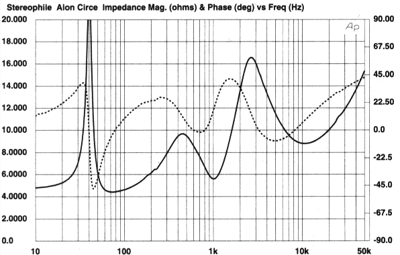
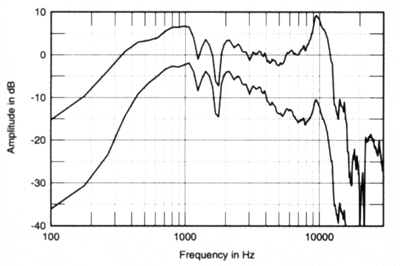
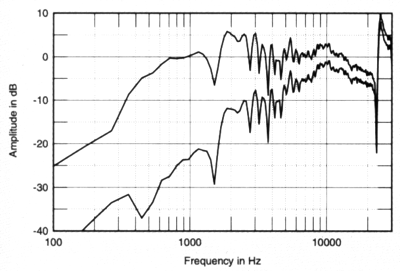
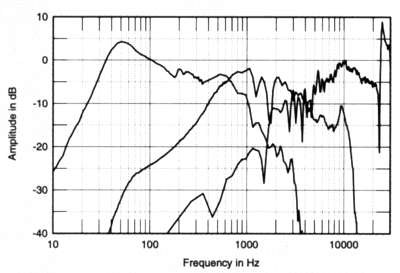
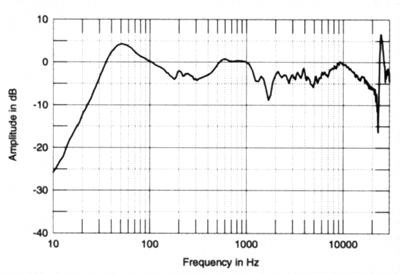
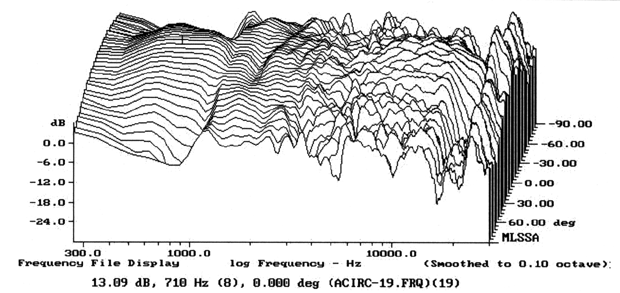
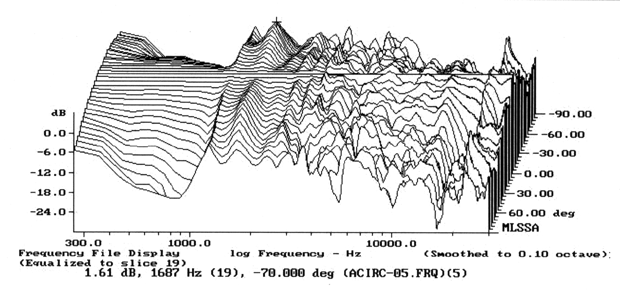
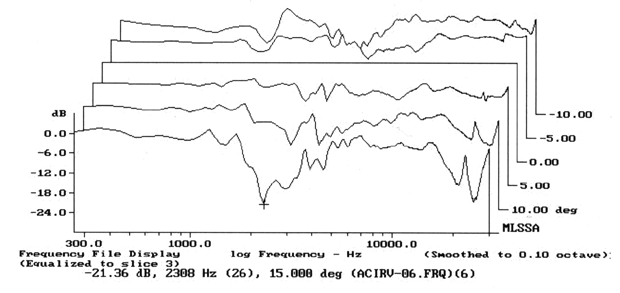
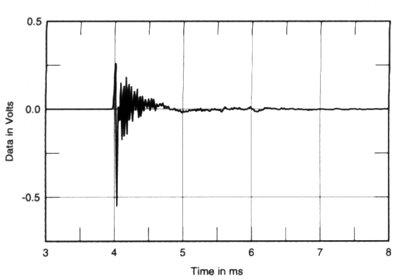
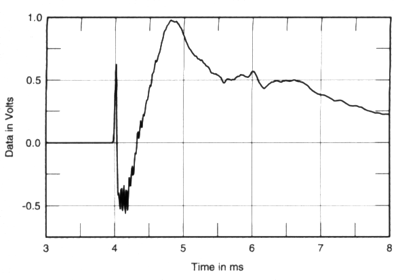
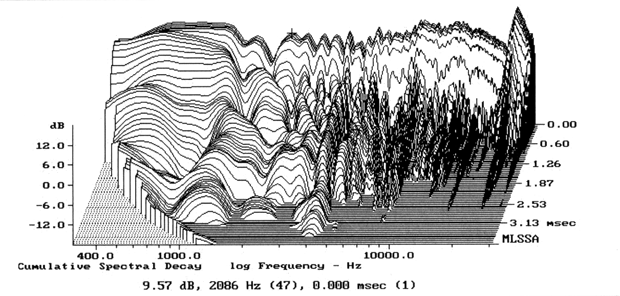
Measurements The big Alón's sensitivity was to specification at an estimated 87dB(B)/2.83V/m. Its impedance plot of magnitude and phase against frequency (fig. 1) dropped below 6 ohms only in the upper bass and upper midrange, with a moderate phase angle across most of the band other than in the bass. The Circe will be relatively easy to drive, which presumably explains why listeners have had success using the speaker with SE triode amplifiers. But note the very high impedance peak at 39Hz: 24 ohms. This will exaggerate the midbass with such amplifiers. It also indicates that the quite large sealed bass bin is tuned relatively high in frequency, which will impact ultimate bass extension.
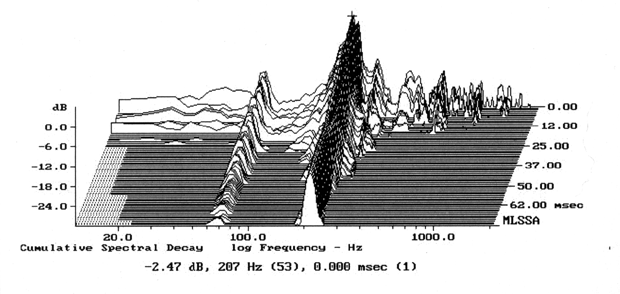
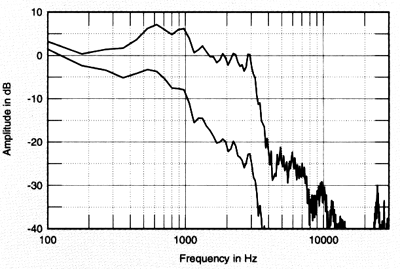
These enigmatic measurements lead me to suspect that the Circe is very fussy when it comes to optimizing setup and room placement. However, as Wes found, with enough care taken, the result can be very musically satisfying. -John Atkinson
|